-
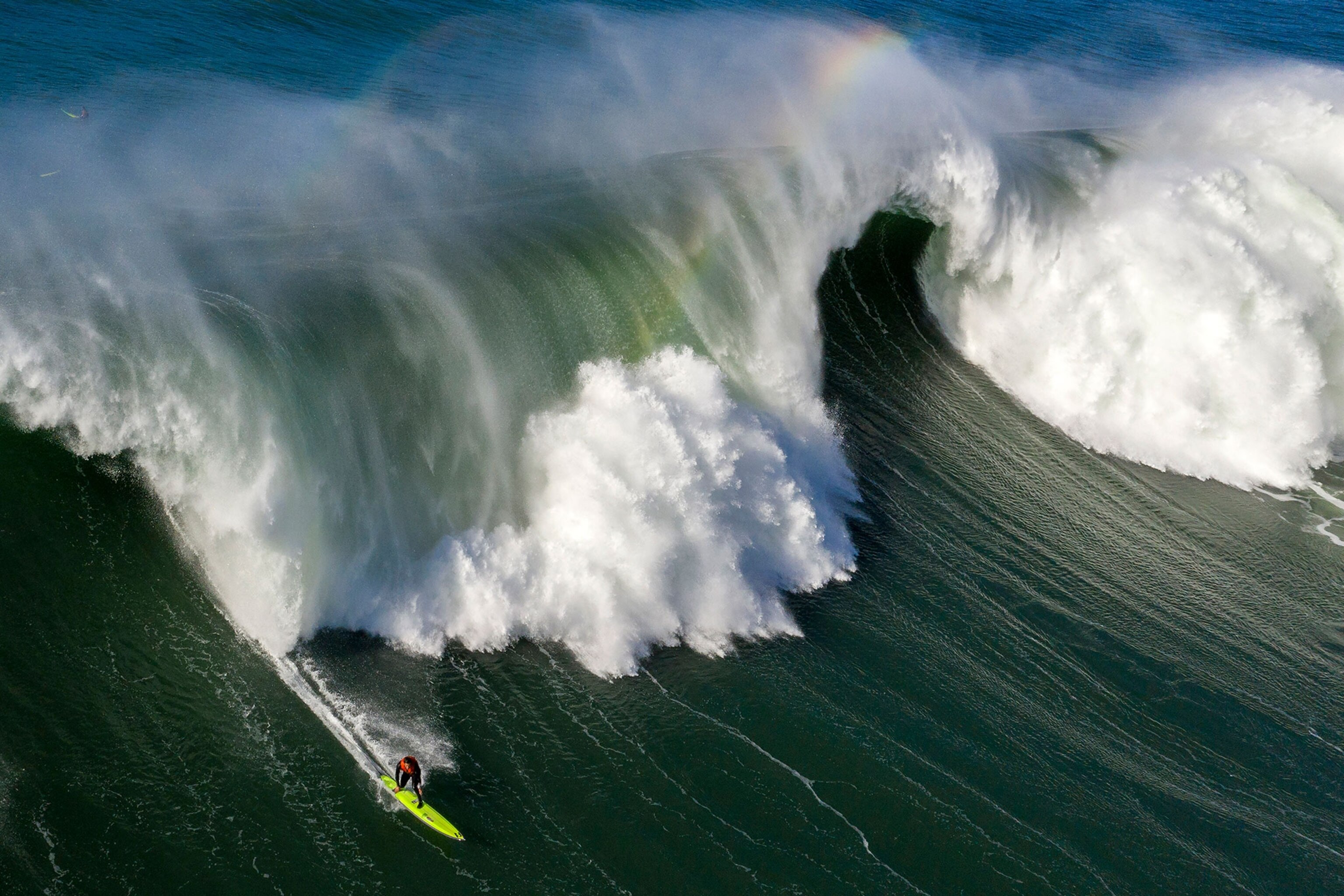
Big-Wave Surfing Teahupoo, Tahiti
Photograph by Fred Pompermayer
“Falling wasn't an option,” was the thought running through the mind of big-wave surfer and waterman Mark Healey as he rode this wave. “Teahupoo is truly one of the wonders of the world. I’ve been making an annual pilgrimage to there for the past 17 years.”
Last week's swells were particularly large—the largest in recent memory—at the wave break just off Tahiti, which beckoned many of the world's best big-wave surfers. From his home in Oahu, Hawaii, Healey had monitored a complex storm system that spawned off of Antarctica. When the storm was 48 hours out and still looked massive, he booked his flight.
“This was a very special wave for me because it was the largest I have ever ridden at Teahupoo. It took a culmination of experience from my years there to ride it successfully,” says Healy. But with the huge waves come huge risks—and some surfers ended up in the hospital. “After I caught this wave, I got on the Jet Ski and towed my friends into some waves and ran safety,” he recalls. “You can't get too greedy. I got what I had come for that day.”
Getting the Shot
“In the morning, the waves were six to eight feet and surfers were paddling out," recalls surfer and adventure photographer Frederico Pompermayer. "At 11 a.m., the first tow-in set came in with a 15-foot swell, which is too big to paddle. After that, the swells increased and picked up. By the end of the day, we saw a couple of sets come in at 25 feet."
Pompermayer watched and photographed Healey catching this massive wave. “Mark Healey was towed into the perfect position with the exact speed he needed to set him up for this insane wave,” says Pompermayer. “This trip was fantastic because we had two big-swell days. It was so crowded—all the big riders from around the world showed up for this swell. It was a challenge to get a good shot on the boat because of the amount of boats and Jet Skis in the area, but I found it exciting.”
Pompermayer shot with a Canon EOS 1D X and a f/4, 70-200mm lens.
-
Skiing Whistler, British Columbia, Canada
Photograph by Reuben Krabbe
“I love skiing for the adrenaline rush as well as the exploration that skis provide,” says skier Dan Treadway, a regular on the pages of ski magazines and seen here hitting a 20-foot cliff in his home turf, Whistler, British Columbia. It had not snowed in a week or so, but Treadway and photographer Reuben Krabbe found creative playgrounds like this one to showcase in the seventh annual ARC’TERYX Deep Winter Challenge, a photography contest where six photographers have 72 hours to shoot in-bounds at Whistler Blackcomb Ski Resort.
“Whistler has North America’s best lift-accessed terrain, and many of the world’s best athletes come here to push their limits,” says Treadway. “I moved to Whistler 18 years ago. The biggest change is that back then you knew everyone, and if you didn't, they didn't live here.“
Getting the Shot
“I had seen other photographs with the idea of shooting action sports from an angle below a cliff but wanted to try a slightly different variation,” says photographer Reuben Krabbe.
Facing mediocre snow conditions, Krabbe focused on the challenging terrain and set up underneath a cliff. “This photograph was the second time Dan hit the cliff. The first time, I asked him to kick a lot of slough off the cliff, so he would be in the air with the falling snow. However, there was so much snow falling that you couldn't see him. The second time we opted for as little snow as possible, and it worked out perfectly,” says Krabbe.
“I love using color to add to the emotion of the shot, so the blue coloring is partially a postproduction technique. We were also shooting on the shadow side of Whistler Mountain and looking up into blue skies,” says Krabbe.
Krabbe finished the competition in second place and walked away knowing Whistler’s terrain better. “I learned a lot from working with both Dave and Dan Treadway. Together they catch a huge number of magazine pages every year, so they know light, terrain, and photography almost as well as many photographers.”
Krabbe photographed with a Nikon D700 and a 17mm f/2.8 lens.
-
Surfing Jaws, Maui, Hawaii
Photograph by Fred Pompermayer
Getting the Shot
“I was so stoked to watch through my viewfinder" as big-wave surfer Shane Dorian was in position for this massive wave, recalls surf photographer Fred Pompermayer. "As soon as he made it through the huge drop, I could see that he was going to make the huge barrel.”
Pompermayer originally was going to skip photographing this early season session at Jaws, a Maui surf break known for its ferocious waves. He changed his plans the night before and arrived on the island the next morning. Two hours after landing, he was in the water capturing Shane Dorian’s winning ride for the Billabong XXL Tube Ride of the Year.
“With the swell picking up in the afternoon, the waves continued to grow,” Pompermayer says. “Just before dark a huge set came in and washed every surfer out. Shane was the only one that was able to make through the sets and was able to stay far out.
“It was an incredible moment. Then he disappeared into the spray of the barrel. It was one of those hold-your-breath kind of moments, to see if he would make it out. I kept shooting and was thrilled to see him reappear. Everyone who saw this ride knew Shane had just scored the ride of the year, no doubt,” Pompermayer says.
Pompermayer shot with a Canon EOS 1Dx and a Canon 70-200mm lens, along with his customized water housing.
-
Climbing Sea Cliffs, Acadia National Park, Maine
Photograph by Tim Kemple
"Come on arms, do your stuff!" was the thought running through climber Hazel Findlay's mind as she climbed this hundred-foot route after a long day on the weathered sea cliffs of Maine. Findlay started climbing on some boulders just above the water; climber Alex Honnold is seen below her. The trip was a stopover after a North Face team expedition to climb sea cliffs in Newfoundland.
"The sea cliffs in Maine were quite small—a hundred feet. The wall in Newfoundland was probably 1,500 feet," says Findlay. "But the cliffs in Maine are right above the water, so that makes it feel very dramatic and intense.
"I actually learned how to climb on the sea cliffs of my own country, so it was really cool to visit some other sea cliffs on the other side of the Atlantic Ocean," says the British climber who now lives out of cars and suitcases. "Often trips aren't about how good the climbing is, but the adventures you end up having getting there."
Getting the Shot
“We needed to air out and dry out, so why not climb in Maine on the way home?” says photographer and adventurer Tim Kemple, who grew up spending his summers climbing in the state. “I was psyched to share the area with friends," which, in this case, included elite climbers Findlay and Honnold. After a soggy shoot in Newfoundland, the trio stopped in at Acadia National Park to climb. “The cliff is called Great Head. I'm not sure of the name of the route or if it had ever been climbed. We were just psyched to finally monkey around after weeks in the rain,” recalls Kemple.
To capture the steep angle and water and to keep the belayer in the frame, Kemple rappelled from the top of the cliff. “I climbed without a shirt on to work on my tan,” jokes Kemple.
See more of Tim’s photography on Instagram: http://instagram.com/timkemple
-
Skiing Portillo, Chile, Overlooking Laguna del Inca
Photograph by Christian Pondella
“We really didn't notice how amazing the ice formations on the lake were when we were shooting,” says Aspen, Colorado-based ski mountaineer Chris Davenport, seen here at Portillo, Chile, overlooking Laguna del Inca. “We knew the snow was amazing, but it wasn't until we looked at the images on the computer that night that we knew we had something special.”
Davenport and photographer Christian Pondella were in-bounds but had hiked about 20 minutes up above the Roca Jack lift into a zone where very few people go. “We had two feet of powder, and then the sun came out and began creating those awesome formations on the lake,” Davenport recalls. “Timing is everything in the mountains, and we timed this shot perfectly.”
Davenport has been hosting events and ski camps at the resort for the past 13 years. "Portillo is truly one of the world's most unique and special ski destinations,” he says. “There is no town there, just a gorgeous, old hotel at the foot of the lake high in the Andes, which caters to all types of skiers and boarders, from families to freeriders. I bring my kids there every season because it's such a kid-friendly mountain—they can't get lost!”
Getting the Shot
“When we first got there, the lake was all open water, then it slowly changed into this abstract formation,” says Pondella, who was in Portillo to ski and shoot with Davenport. “I had photographed in Portillo before, but never had this particular shot in mind. It was not until this trip that we watched the lake transform like it did."
Pondella and Davenport shot the entire day without getting the particular frame they had in mind, due to the terrain. The two had to wrap the shoot in order to catch a bus and make a flight home. “As we were skiing down to the bottom, I looked over and saw this one patch of snow with the lake behind it and shouted to Chris, ‘That’s our shot,’" Pondella says. "This was the last shot of our trip, and for sure the best one as it all came together exactly as I had envisioned earlier in the day."
Pondella photographed with a Canon Mark 1D III and a f/4, 24-105mm lens.
-
Snowboarding in Laax, Switzerland
Photograph by Lorenz Richard, Red Bull Content Pool
Getting the Shot
"This was the first camp for me—it was actually the first of its type in Europe, so I was quite happy to hang out with such young, talented riders," says photographer Lorenz Richard, who took this shot of Dutch snowboarder Dimi Dejong at the Red Bull Junior Snow Performance Camp in Laax, Switzerland. "The goal was to tell the whole story of the event with action, lifestyle, and portrait images. It was more of a reportage, which I really like."
"A big challenge was the weather. It changed from sunny with blue skies to cloudy and over-shiny conditions within minutes. Everybody was motivated to get shots," recalls Richard. In a controlled event environment it can be difficult to capture unique photographs. "I had two approaches. First, the pipe in Laax is quite known for images with the round restaurant in the background, so I wanted to avoid that angle; The second approach was more graphic. While shooting, I was trying to get the images as clean and organized as possible. I think when you are spontaneous you get the best shots."
See more of Richard's photography on his website.
-
Climbing Red Dihedral, Eldorado Canyon, Colorado
Photograph by John Dickey
“Getting to the top of a climb that you put your heart and soul into is always less satisfying than going through the process of being able to do it,” says climber Jesse Huey, seen here free climbing the challenging Red Dihedral route located an hour-and-a-half hike from his doorstep in Boulder, Colorado. Huey had attempted this route over eight days in January 2013. “When I saw that several holds had been broken, it took way more effort to figure out the route than what I had originally anticipated,” says Huey of the sandstone conglomerate.
Even on cold winter days like this one, it was still too hot to climb in direct sunlight, so timing had to be just right. “Below where this photo was taken was a bit of climbing so difficult that if it was even remotely too hot, your shoe rubber would not stick to the friction of the wall,” recalls Huey, whose climbing partner Josh Wharton was bundled up in down jackets on belay below him. "Then when the shade hit, we had less than an hour to climb before we couldn't feel our fingers."
On the day that he actually completed the climb, Huey went to yoga the night before and spent an hour warming up in the gym before hiking out to the climb. “It actually became very stressful because of a looming raptor closure for the area that went into effect January 31,” says Huey. “I finally finished on January 31. That felt really great.”
Getting the Shot
“I went to shoot Jesse on the Red Dihedral because of its notorious reputation,” recalls photographer John Dickey. “And shooting images gives you the best seat in the house for all the sports action.”
Keeping pace with Huey kept Dickey challenged as he was planning the photographs he wanted to capture. “That day conditions were too hot for success in direct sunlight, which was very fortunate because I got to shoot Jesse trying extra hard, right as the shade line was creeping up,” says Dickey. “I had seen the lighting effect previously on that wall and was hoping the timing would work out as it did.”
After watching Huey work the tough route for a few days, the right elements aligned. “The lighting was all natural and timing alone allowed it to come together. I had sat and watched the shadow line several days before and timed it out with Jesse's ambitions,” recalls Dickey.
Dickey photographed with a Canon 5d Mark II and a Canon 20mm, f/2.8 lens.
-
Skiing Mount Mackenzie, British Columbia, Canada
Photograph by David Carlier
"It's not normal to have this kind of view, but it's very artistic," says French skier Julien Lopez. "We call that a sea of clouds, and it makes the mountain even more beautiful." Lopez was competing in the first event of the Freeride World Tour on Mount Mackenzie, near Revelstoke in British Columbia, Canada, in January 2013. "I could see a part of the terrain, but not everything—but I knew the mountain face, so didn't matter to me."
On Lopez's back is an avalanche airbag backpack loaded up with a shovel, probe, water, and snacks so that he would be prepared in the event of a slide.
In the middle of his run he had to drop a massive cliff, but he had looked at the spot for a long time and knew exactly what to do when he got there. "I got third place, so I guess I had a good run. The snow conditions were so good."
Lopez, who lives in Tresserve, France, started skiing when he was a year old and loves surfing and mountain biking in the summer.
Getting the Shot
With the race set to begin, photographer David Carlier knew the shot he wanted to capture. "The light was beautiful due to the very cold air and a very low sun. I knew that skier Julien Lopez, aka the Flying French Man, would go big, straight off the starting gate for his first Freeride World Tour contest in 2013,” says Carlier.
“I positioned myself right on the edge of the face to be able to shoot Lopez in the air to give a dynamic angle to the photo. I wanted to capture the competition venue visible under his skis, with Julien literally jumping into the clouds. His athletic body position gives a lot of dynamic energy to the shot, and the clouds give a sense of remoteness and elevation.”
Carlier battled bitter conditions throughout the competition. “That day was very cold, -35°C/-31°F on top of Mount Mackenzie. With the extreme freezing conditions it was pretty hard to operate my Nikon D800 control wheels and buttons with big gloves, so I had to take them off to make the shots,” recalls Carlier.
-
Ice Climbing Mýrdalsjökull Glacier, Iceland
Photograph by Michel Roggo
“The light in Iceland in the wintertime has more shades and tones than anywhere I have been—it feels like being on an ice film set in Mordor in Lord of the Rings,” says 16-year veteran ice climber Tim Emmett, seen here climbing Iceland’s Mýrdalsjökull Glacier, which was ashy from a recent volcanic eruption.
Emmett and climbing partner Dawn Glanc, pictured on belay, spent ten days in the land of fire and ice climbing new routes and meeting the locals. “Iceland was going through a warm spell, so we looked for a glacier to climb instead of an icefall,” recalls Emmett, who is moving to Squamish, British Columbia, to take advantage of its easy access to world-class adventures. “This was a perfect, very surreal day of climbing.”
Getting the Shot
On this trip, the biggest challenge wasn’t the climbing, but battling the weather. “The snow we were experiencing in Iceland was more like falling slush—it soaked everything,” recalls photographer Keith Ladzinski. “Keeping the gear dry was a huge challenge. Much of the time I was shooting with my jacket over the camera, when possible. I brought two small towels and used them more or less, nonstop.”
Racing a pending storm in the otherworldly landscape, Ladzinski and crew climbed the Mýrdalsjökull Glacier as dark clouds rolled in. As evening approached and the sky took on a purple haze, Ladzinski used a split-neutral density filter to help retain his exposure and darken the sky in the mixed lighting. “Bad weather generally makes for the best photographs,” says Ladzinski. “Dramatic and foreboding clouds made for the perfect sky and the overcast weather, which only made the blue glacier that much more vibrant.”
Ladzinski photographed with a Nikon D800 and 16-35mm lens.
-
Climbing Myrdalsjokull Glacier, Iceland
Photograph by Keith Ladzinski
Tim Emmett climbing Myrdalsjokull Glacier as a storm approaches, Iceland
-
Bodyboarding Pipeline, North Shore, Oahu, Hawaii
Photograph by Ray Collins
“All I do is push a button," says surfing photographer Ray Collins. "At the end of the day, the people riding the waves are the heroes."
In February 2013, Collins was photographing at Hawaii’s famed Pipeline break. "That day it was big, rogue Pipeline. Whether shooting in the water or on land, there is always something new to learn, fear, and respect," says Collins, who has shot several seasons at this wave. "It was between the surfers' Pipe comp and the bodyboarders' Pipe comp, so the best of the best were out there."
Collins captured this shot of an unknown bodyboarder taking on a wave that no one else rode. “What is known is that the wave crashed—it shook the ground when it broke, and it broke directly on him,” he says.
“Sometimes it can make you feel a bit sick to witness these moments," Collins says. "I struggle with that, especially when I’m in the water, too, but it’s my job to document it. I just want these guys to be able to go home safe, to their loved ones, at the end of the day."
Collins photographed with a Nikon D4, a 200-400mm lens, and a 1.4x converter. Follow him on Instagram @raycollinsphoto.
-
Rock and Ice Climbing in Santaquin Canyon, Utah
Photogrpah by Jeremiah Watt
“At this moment I was thinking how radical it was going to be to swing out onto that dagger of ice,” recalls climber Scott Adamson, seen here on a new route called the Angel of Fear in Utah’s Santaquin Canyon. “The moves going out to the dagger are not all that difficult physically, but you should still be heads up so you don’t skate off,” notes Adamson, a 15-year ice-climbing veteran. “After I weaseled in some good rock protection the climbing seemed mellow.”
This is a mixed-climbing route. First the climber ascends a steep rock roof, then he or she committs to this ice traverse. “I strive to find routes that have big ice daggers and to climb naturally with gear. This route has natural gear placements for cams, nuts, etc.,” says Adamson, who lives at the base of Utah’s Wasatch Mountains and works as a climbing and canyoneering guide in Zion National Park in the summer.
Getting the Shot
“It was pretty rowdy—a crazy little dagger, hanging in space,” says photographer Jermiah Watt of the ice dagger that had formed a few hundred feet above. Watt had photographed in the region before, under different conditions. The previous year, in this spot, several tons of ice had cascaded down the entire wall. “This was a first ascent, so we weren't quite sure what to expect or whether the ice would even allow things to work.”
To capture this shot, Watt set himself at the same height as Adamson by equalizing an ice screw and bolt above and behind himself. “I really wanted to give an idea of the position Scott was in—thin ice and little gear with this crazy dagger just hanging out in space—and for me that translates into working my way in close with a wide-angle lens." Racing against waning light, Watt worked carefully as Adamson climbed. “I would wait for Scott to get into dynamic, angular positions that somewhat mimicked the geometric form of the ice. I was hoping to create an attraction of sorts between the climber and dagger.”
Watt photographed with a Nikon D800 and 16-35mm f/4 lens.
-
Backcountry Skiing Frazier Basin, Bridger Range, Montana
Photograph by Ryan Krueger
“I had just dropped in off the ridge,” recalls skier Luke Smith of carving this line in Frazier Basin in the Bridger Range near Bozeman, Montana. “I was going pretty fast and the snow was sluffing a lot. It felt great, and I was just enjoying it.” On this day the conditions were perfect—powder with a low risk of avalanches. “I didn’t even notice the pillows on the way down,” says the Alaska native who now lives in Girdwood. “There are several pronounced chutes at the bottom of the face with large sections of rock between them, so I was pretty focused on finding my exit.”
Getting the Shot
“I had seen the snow features when we got to the area, but once Luke decided where he was going to drop in, I knew that we were going to be able to make a great photo,” recalls photographer and Bozeman local Ryan Krueger. “The features don’t always form in the same way, but on this day they looked especially unique and we were lucky to be able to shoot them.”
Krueger hiked up the ridgeline and positioned himself to capture Smith. “This was his second turn down the face and he already had plenty of speed, as he made a big left-hand turn into the perfect spot to capture the photo,” says Krueger. “It’s always a challenge trying to assess the snowpack and make sure that we make safe decisions. On this day, everything came together perfectly.”
Krueger photographed with a Canon 5D and carried 24-70mm and 70-200mm lenses.
-
Surfing the North Shore, Oahu, Hawaii
Photograph by Matt Kurvin
"This wave was the best ride of my life so far," says Tiago Gil, seen here at sunset on Pipeline on Oahu's North Shore. "I remember paddling into it—I was frightened. I got to the bottom of the wave and looked up and saw the meanest wall of water I've ever seen. Being inside the barrel was so loud, then it turned quiet. It gets so peaceful a split second before it turns into a life-or-death situation." The Sunset Beach, Hawaii-based surfer is a true adventurer who rides waves for the love of it, not for sponsors. "Then I popped up and had never been happier."
Getting the Shot
“It is always rewarding to get a good shot of one of the underground guys," says photographer Matt Kurvin, a regular photographer at Pipeline, where he came to know Gil. "It's not their job, they just do it for the love of it, and it shows in their determination out there. No sponsors, no paycheck from the industry, he just does whatever he needs to do to get by, just to surf this wave.”
After packing up at the end of the day, Kurvin saw this set of waves breaking. “I made a mad dash to get the camera out and lens cap off just in time to capture this. I stayed low to frame the beach, water, and sky," says Kurvin. "I love Pipeline in the evening; the green glow of the lip and yellow sky tends to make the photograph look almost three-dimensional.”
Kurvin photographed with a Canon 5D Mark II and a 100-400mm lens.
-
Climbing Wings of Desire, Penticton, British Columbia
Photograph by Ryan Creary
Getting the Shot
"It's very classic and aesthetic," says photographer Ryan Creary of this route, Wings of Desire, climbed by Canmore, Alberta-based guide Marco Delesalle in the Skaha Bluff near Penticton, British Columbia. "It’s one of the lines that stands out right away when you approach the wall.”
The overcast day was perfect for lighting the scene Creary had in mind. “I wanted to try and get a different angle than other routes I had shot from above in this area,” he recalls. After a quick scramble to a boulder perched on a talus slope below the wall, Creary was perfectly aligned to frame Delesalle and the graphic rock.
“I really wanted to showcase the color of the rock," says Creary. "It really stands out, and it’s a very obvious line from that angle. Since it was a bright overcast day with few shadows to deal with, the colors popped very nicely."
Creary photographed with a Canon 5D Mark II and a Canon 70-300mm lens.
-
Skiing Blackcomb Mountain, British Columbia, Canada
Photograph by Reuben Krabbe
"I knew I had to stick the landing and straightline through the choke in the rock," says big-mountain freeskier James McSkimming of descending this chute, known as Wild Thing Feeder, in Diamond Bowl on Blackcomb at Whistler Blackcomb Ski Resort in British Columbia. "Any error would have sent me crashing into rock—fortunately my landing was good." The Whistler native had never skied this line prior to the shot and has not since. "It is rarely in condition and quite committing." But it is challenging features like this that keep McSkimming happy to live in his hometown. "I love to travel and see new places, but so far this is the place I like to come home to."
Getting the Shot
“Setting up the shot took quite a while because it is such a technical feature with a narrow landing that the skier cannot miss," says photographer Reuben Krabbe. "I wanted to be sure the photo was worth James's risk attempting the line.”
Krabbe says the biggest challenge of this photo was lining up everything for a one-time shot—and getting to this angle without making it more dangerous. "I skied to the bottom of the chute, and climbed up the side, and tried to not disturb James's run out,” says Krabbe.
Working with the ambient light, Krabbe captured the tone of the overcast weather that day. “All the lighting is natural. I love capturing the way things look and feel, realistically," he notes. "Using flash on a feature like this could make for a poppy, exciting image; however, that would sacrifice the cold, organic, overcast feeling of the day."
Krabbe photographed with a Nikon d700 and 17-35mm lens.
-
Backcountry Skiing Prospectors Peak, Grand Teton National Park, Wyoming
Photograph by Kim Havell
Getting the Shot
“To ski this line, you need to come prepared with the correct gear—rope, webbing, harnesses, carabiners, whippet, and ice axe,” says ski mountaineer and photographer Kim Havell of this image of Erica Engle on Prospectors Peak in Grand Teton National Park. "I shot the whole way down. Everyone skied as they would, and I set up quickly around the points of safety in the couloir. It was dark on the north side, but contrast came through with the white, fresh snow, the skier, the steep slope angle, and the rock,” recalls Havell.
After crossing paths in Jackson Hole’s backcountry, Havell joined skiers Engle and Brian Warren to ski the north facing Son of Apocalypse couloir. “We had no idea what to expect going in. We hadn't heard of anyone skiing the route yet this season, which is part of the fun and adventure,” says Havell. “It was extremely cold, a minus 20F start, and since we were on the north side on a cloudy, stormy day, it stayed chilly.”
Son of Apocalypse is a more challenging run early in the winter season, but its northern position also provided the team some protection from the elements. “We made two rappels and one small rock jump out the bottom to the exit apron and leapfrogged down the run," says Havell, who is based in Jackson and has climbed up and skied down ambitious mountains around the world.
-
Tour Down Under Cycling Race, Australia
Photograph by Gregg Bleakney
Getting the Shot
“The temperature outside was over 100 degrees and the cockpit started to heat up like a sauna,” recalls photographer Gregg Bleakney, who shot this image from a helicopter above the 2012 Tour Down Under in South Australia. “All I could think about was how the cyclists were going to manage the swelter—most had just hopped off a plane from mid-winter in Europe.” Bleakney went to the road race to capture a specific photograph he had in mind. “My goal was to find the cyclists over an interesting geographical feature and to let that feature dominate the frame." To reach those features, at the right time, he cross-referenced the helicopter takeoff duration, flight speed, the actual start time of the race, and the estimated average speed of the peloton. “The timing needed to be perfect and a bit lucky," says Bleakney. "The helicopter was only allowed two or three turns over the peloton at each intercept point.”
A delayed takeoff quickly changed Bleakney’s detailed plans to get the shot. "I knew that by the time the cyclists rolled past the feature that I'd be too far aloft to make the frame I wanted with my zoom lens," says Bleakney of getting this shot above crops along the border of the Barossa and Clare Valleys in Australia's iconic wine country. So he quickly swapped from his full-frame camera body to his backup camera, which had a sensor that pushes the zoom from 200mm to 300mm. "I simply crossed my fingers and hoped for a little serendipitous karmic love—and that led to this picture.”
To cover the race, Bleakney photographed with a Nikon D700 and Nikon D7000 camera bodies, along with two Nikon lenses, a 24-70mm, f/2.8 and 70-200mm, f/2.8.
-
Kayaking Over Tomata 1 Near Tlapacoyan, Mexico
Photograph by Tim Kemple
“This is the critical moment when everything goes right or everything goes wrong,” says extreme kayaker Tyler Bradt, seen going over 65-foot Tomata 1 in Tlapacoyan, Mexico. It’s important for waterfall kayakers to land precisely, and that is influenced by their actions at the lip of the waterfall and into the first 20 feet of free fall. “At this moment, I was focused on setting my angle correctly. Some of the beauty of waterfall running is a separation from thoughts and the purity of existing in complete presence with such an amazing force of nature.”
On this expedition, kayakers Bradt and Erik Boomer joined a talented team of filmmakers for a ten-day shoot in Mexico to produce the short film Cascada. For Bradt, who set the world record on Washington’s 186-foot Palouse Falls in 2009 and then broke his back on 95-foot Abiqua Falls in 2011, running these waterfalls had a special significance. “Breaking my back hit the reset button for me in my waterfall running. I had to start back at the beginning and work up,” notes Bradt, a consummate adventurer who is now planning a trip to sail around the world. “This was the first time I finally felt right to run big waterfalls after over 18 months of striving to get back to that spot.”
Getting the Shot
“We could have touched the paddlers as they went by,” says adventure photographer Tim Kemple. “We were literally dangling a few feet away from the lip of the waterfall.” Kemple joined a team of filmmakers—Anson Fogel, Skip Armstrong, and Blake Hendrix—in Tlapacoyan, Mexico, to capture kayaking images as never seen before by rigging up ropes to capture shots as only rock climbers can.
“The idea of this vertigo-inducing view, looking straight down a waterfall, was definitely one of those shots that we talked about before arriving in Mexico,” recalls Kemple. “We weren't the first people to shoot images in Tlapacoyan, far from it. That became the challenge: How could we use light, perspective, and creativity to capture images that people hadn't seen anywhere before?
“Kayaking waterfalls is a one-take situation. Even if the paddlers enter the water cleanly, it hurts, like getting punched in the face,” says Kemple. “It’s hard to believe Tomata 1 is only one-third the height of the biggest waterfall Tyler has run. We hadn't met before the trip, but I can honestly say that I can't wait for my next adventure with Tyler.”
Kemple used a Phase One 645DF+ with IQ180 digital back and 28mm lens at 1/1600th shutter.
-
Climbing the Tempest, Cascades, Washington
Photograph by Garrett Grove
"The Colchuck Balanced Rock is a perfect chunk of steep white granite—it just calls out to be climbed," says climber Scott Bennett, seen here trad climbing on the Tempest wall near Leavenworth in Washington's Cascades. Climber Blake Herrington, who was belaying Bennett in this photo, did the first ascent of this route a few years earlier during a ferocious storm. But on this day the perfect weather made for a spectacular view. "This climb took us the better part of the day, but we made it back to camp for dinner and beers."
Getting the Shot
“We went to the Cascades because many new, modern alpine climbing routes have been established in the last five years by some dedicated locals around Washington,“ says photographer Garrett Grove. “We were climbing the Tempest wall all day and knew this route would specifically hold the best sunset light,” recalls Grove.
Grove rappelled to the end of his 70-meter rope to make sure he was at the best distance to allow for both wide and tight shots. “When Scott started climbing up and around this corner, it all came together really well," Grove recalls. "I framed the photo tighter to bring out the depth and details in the background,” says Grove.
Grove photographed with a Nikon D3s and a Nikon 24-120mm, f/4.0 lens and a Singh Ray 3 Stop Graduated ND card.