-
How to Pack (Very) Light
Video still by Byran Smith
Colin Haley specializes in climbing the world’s largest and steepest mountain faces. They require the cardiovascular fitness needed to summit Mount Everest and the carefully honed technique required to climb Yosemite’s El Capitan. Sherpas don’t haul loads to established high camps. Haley doesn’t rely on the fixed ropes that run like ladders up the 8,000-meter peaks.
What he needs to climb a mountain goes in his backpack. It’s not surprising that Haley is exacting about every item he carries with him. While you probably won’t be packing to climb the West Face of Cerro Torre or the North Face of the Ogre II, Haley’s thought process on what to bring is applicable to any human-powered adventure. Here’s what goes through his head and keeps his pack light.
Little Things Add Up Over Time
“Even small amounts of weight—the difference between a 120-gram fuel canister and a 250-gram fuel canister—can translate into a big difference in exertion when that fuel canister is carried up 2,000 vertical meters,” says Haley. All-day or multiday adventures amplify each ounce. Don’t just consider what you need, consider how much of a given item you are going to use.Comfort Is a Luxury
"Every item I bring is something I feel is either important to succeeding or important to staying alive. An item that makes me more comfortable, but isn’t critical to success or survival, is left behind,” says Haley. Collect as much pre-trip data as possible—from weather reports to campfire conversation—to formulate a checklist. Based on that information, imagine the absolute bare necessity of what you need to be successful and bring that.Let Experience Guide You
"The truth is, learning by experience is the only real method. Every time you go out think about what items of gear would have been useful if you had brought it, and then look at what gear you brought that was superfluous,” notes Haley. If too much weight bogs you down on a summit bid of Mount Rainier, don’t return with the same strategy and expect a different result. Subtle experimentation is key.
—By Fitz Cahall
Learn more about Colin Haley in this video >> -
Five Tips for Runners Hitting the Trail
Video still by Byran Smith
In the last decade, ultramarathon runner Krissy Moehl has won some of the world’s most difficult trail races in some of the most inhospitable conditions. She started like most passionate runners—more used to pounding pavement than fording rivers. Wilderness running is a different game from running through city streets. Moehl offers up five tips for runners looking to hit the trails.
1. The Buddy System
“Something special happens when you share a trail run with someone,” says the 33-year-old Moehl. “When you get to a vista, it means that much more when you can turn to a friend, and say ‘Wow, look at this.’” To Moehl, teaming up isn’t only fun; it’s safe. “When you’re navigating trail systems and you’re tired, having two brains to pull on is key,” she adds.2. Maps Help
“Figure out your maps and route before you go,” says Moehl. Photocopy key trail guides so you aren’t dragging a hiking guide with you. “I even highlight my route, so I don’t have to think about it when I’m on a complicated trail system,” she says. A Ziploc bag keeps the map clean and dry.3. Know Your Gear
“I’ve been overprepared and I’ve also had to ask other people for food and water,” says Moehl. Long-distance trails often mean carrying a small, ultralight pack with water and enough food to feed your body throughout the run. “On long runs, I pack an extra layer, a lightweight wind jacket, and enough food for me—and a little extra in case my partner runs out,” she adds.4. Pace Yourself
“If you run in the city, you aren’t used to having to eat during your runs,” says Moehl. “On trails, you work at a lower heart rate, in part so that you are able to eat.” Plus, you’ll be traveling through beautiful country—no need to hurry.5. Tell Someone Where You Are
“A trail run doesn’t have to be epic to let someone know where you are. I always give friends a return time. Give yourself a window, in case it takes a little longer than you plan for.”
—By Fitz Cahall -
Gear for the Aspiring Adventure Filmmaker
Video still by Byran Smith
In the age of YouTube, documenting personal adventures has become a pursuit in its own right. When 35-year-old adventure filmmaker Bryan Smith first pulled out a video camera eight years ago, he had no idea what he was doing. Now he’s shooting regularly in some of the most extreme environments on the planet. Here are five pieces of gear that Smith wishes he had right from the start.
1. Basic Audio Kit
“Good audio brings a story to life. Even a simple shotgun and lavalier mic kit will go a long ways to improve your work,” says Smith. A decent mic is arguably more important than an expensive new lens. Smith suggests Sennheiser's MKE102-EW lav mic kit coupled with a RØDE NTG3 shotgun mic, which will cost less than $1,000, but make your work feel like a million.2. Effective Storage
“There is nothing worse than fumbling through your gear trying to not drop things or keep them dry,” Smith says. In the field, Smith has to deal with snow, water, sand, and dust. “Every sport you shoot requires a slightly different way of carrying equipment, but a sturdy camera bag is essential.”3. An Adventurous Laptop
"While the a laptop doesn't always travel with me in the field, it's never far away for downloading footage to hard drives," says Smith. Most adventure filmmakers go with a MacBook Pro. It's trim, but has enough horsepower to handle and process large HD files quickly. Apple's Final Cut Pro ($999) has become the standard editing tool for upstart filmmakers. If you're just start out, consider purchasing Final Cut Express ($199). An Apple Care plan is a must—your computer will be subject to the same wear and tear as your camera gear. Pelican Case makes a rugged hard shell, foam-padded case for your laptop for around $100.4. Sense of Humor
“It’s just a matter of time before you have a bit of an epic episode of filmmaking. No batteries, moisture shut down, flat light—it’s going to happen,” says Smith. When it does, laugh about it. “You film adventures because it’s fun. Don't worry about screwing up; just learn from it and get better.”5. Weight Set
“That’s right, you’re going to need to be strong. If you are chasing after athletes who are better than you are in a given sport, you better start training,” says Smith. He’s only half joking. A given day in the field might mean following an elite mountaineer 5,000 feet up a mountain. “To save gym fees, push-ups and pull-ups daily could be substituted,” Smith adds.6. Pro Tripod
“It’s not cheap, but a good tripod is one of the most overlooked pieces of initial gear.” Smith suggests splurging. “Don't spend $300, spend $1,000 or more. A smooth fluid head is one of a filmmaker's most important tools.”
—By Fitz Cahall
Learn more about Bryan Smith in this video >> -
The Basics of Deepwater Soloing
Video still by Byran Smith
“There are only two mandatory criteria for deepwater soloing—overhanging rock and deep water. It’s pretty simple really,” says rock climber Matt Maddaloni, who helped bring this subsport into fashion in the early 2000s.
In climbing talk, free soloing is the act of climbing without a rope. Without the safety net of a rope, if a climber is more than 30 feet off the ground, a fall means death. “I was attracted to that kind of climbing, but I realized it has its limitations. You can’t push the difficulty,” says Maddaloni.
Minimal Equipment Required
Deepwater soloing takes away a good bit of the danger by replacing the ground with water. Typically, climbers use a small boat or canoe to get themselves to a remote sea cliff. Aside from a pair of shoes and bit of climbing chalk, climbers don’t need any gear, ropes, or harnesses. With water below, a climber can execute acrobatic and difficult climbing moves and risk falling. While injury is definitely a possibility, most of the time a fall just means a short swim through warm ocean water to a waiting boat.When It Started
While deepwater soloing began in late 1970s on the sun-soaked sea cliffs of Mallorca and along the damper, chillier British coast, it wasn’t until the early 2000s that the climbing community began to embrace the sport’s newest trend and started flocking to Vietnam and Thailand’s limestone towers perched above calm bays.Find the Right Rock
“Typically, limestone is the best rock for deepwater soloing,” says Maddaloni who authored a guidebook to deepwater soloing around Thailand’s Krabi region and established new routes in Vietnam and Malta. “It’s softer than granite, so the sea erodes away at the base and creates overhanging cliffs. That way you’ve got a clean shot into the water.”Experience Required
Due to the overhanging nature of the rock, deepwater soloing tends to be difficult with the easiest routes checking in at 5.10. In Fringe Elements video “Safety Third,” Maddaloni found a suitable new route on the granite sea cliffs surrounding Squamish, British Columbia. However, the coastal waters of B.C. aren’t quite as warm as the Mediterranean.“The water was so cold, I had to wear a wet suit,” remembers Maddaloni. “It was super difficult because once the suit was wet, water would run out onto my hands and feet as I was climbing.”
—By Fitz Cahall
Learn more about Matt Maddaloni in this video >> -
Kayaking Tidal Races Basics
Video still by Byran Smith
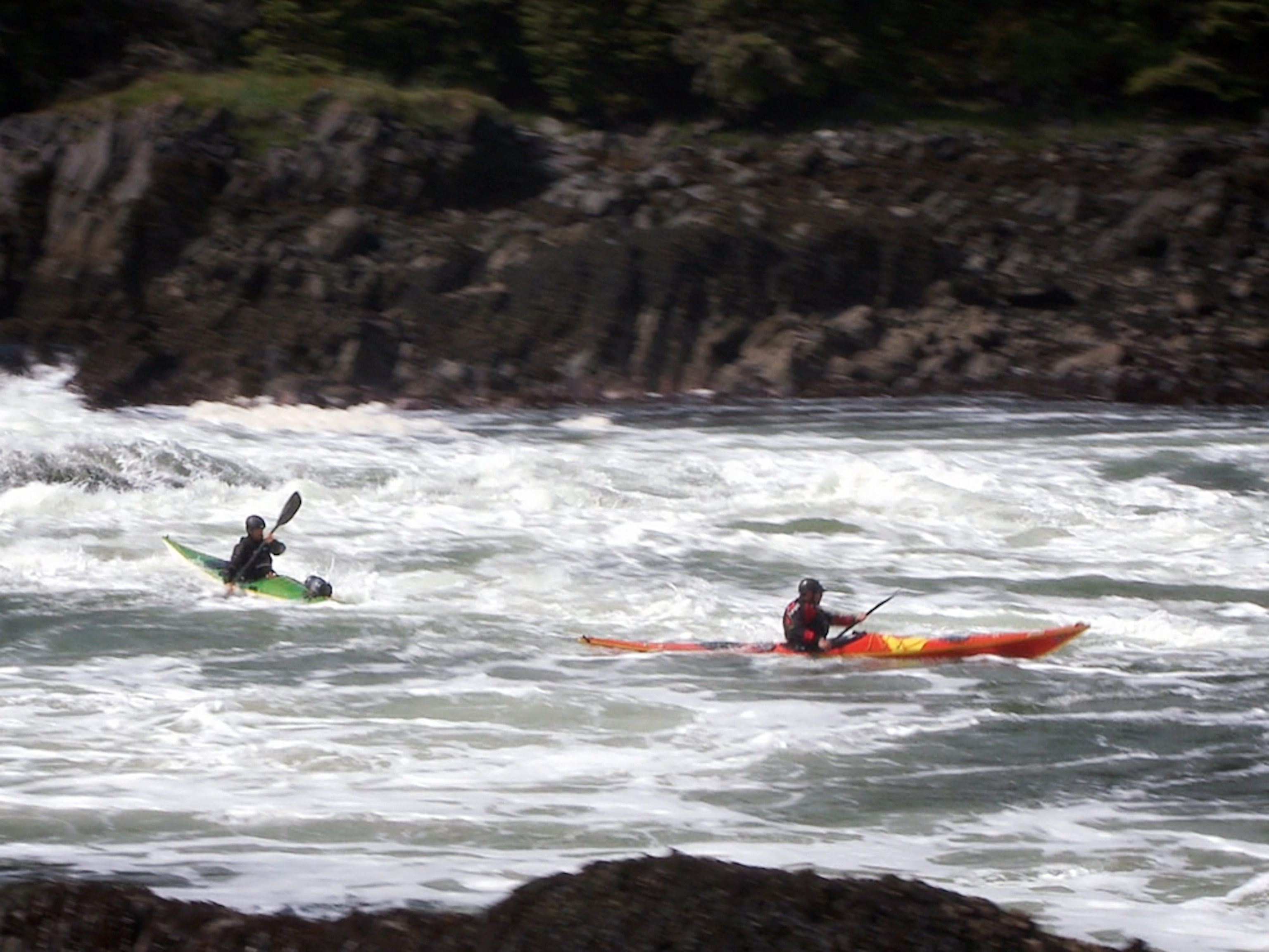
“Even the biggest tidal races can be caught when they are small,” says sea kayaker Paul Kuthe of the river-like currents, whirlpools, and rapids that tidal shifts can cause in the ocean. “Most can be paddled into when they are completely flat. Then the rapid slowly builds around you. You can scout it out this way.”
Necessary Skills
Paddling tidal races—the river-like currents, whirlpools, and rapids that tidal shifts can cause in the ocean—requires mastery of basic sea kayaking skills. Before you drop in, you should be confident with your ability to roll a kayak, know how to re-enter your boat in open water should you swim (fall out of your kayak), and formulate a basic understanding of all the entry and possible escape points inside a tidal race.Where to Go
Deception Pass on Whidbey Island, located an hour and a half north of Seattle, and Yellow Bluffs in San Francisco Bay are the best entry points for sea kayakers looking to make the leap into tidal race paddling, says sea kayaker Paul Kuthe. They contain similar features—standing waves, chop, and whirlpools—to the tidal races seen in Fringe Elements, just on a smaller scale. A few sea kayaking outfitters offer guided trips to these zones where paddlers can develop the skills they will need for bigger races, such as British Columbia's Skookumchuck Narrows, under a guide’s watchful eye. “These are good places for people to cut their teeth and figure out how to paddle in tidal races,” says Kuthe.Stay Warm
With their proximity to major metropolitan areas, Deception Pass and Yellow Bluffs are also the easiest tidal races to get to. These are cold-water locals where water temperatures hover in the 50s, so come prepared. Even with a dry suit and insulation underneath, a kayaker who comes out of his or her boat only has 20 minutes before hypothermia sets in, warns Kuthe.
—By Fitz Cahall
Learn more about Paul Kuthe in this video >> -
The Evolution of the Splitboard
Video still by Byran Smith
In the last year, splitboarding has reached a tipping point. Ski movie stalwarts Teton Gravity Research released Deeper, which featured snowboards that transform into skis, to much fanfare. In the last three years, several snowboard companies have begun aggressively marketing these backcountry boards. Splitboarding may seem like a new sport, but in actuality, it’s been sitting on the fringe of snowboarding for almost 20 years.
The Early Years
In the late 1980s Brett Kobernick began tinkering with boards. He hand-cut standard snowboards in half to fashion skis for uphill movement and slapped a set of adhesive climbing skins to the bottom. At the top, a rider could simply remove the skins and reconnect the board for downhill riding. In 1992, Kobernick partnered with Salt Lake City, Utah, ski manufacturer Voile. By 1994 the hardware to split a snowboard hit the market. At first, snowboarders looking to hit the open backcountry away from resorts had to purchase the Voile kit and chop a snowboard in half on their own. For a lot of consumers the thought of cutting a board in half in a garage was hard to handle.The Modern Splitboard
Eventually, Voile began marketing factory-made splitboards for the small market. Snowboarding giant Burton offered a version for a few years, but discontinued it. In the last three years, as the pull of the backcountry has hit the masses, there are now a dozen or so splitboard manufacturers who produce different shapes and sizes to suit a rider’s ability, style, and size. The new boards are smaller, lighter, and more maneuverable than the previous generations. A few companies have begun to create bindings specifically designed for splitboarding, and now snowboarders can keep up with skiers. The sport is evolving rapidly yet the concept remains the same. Ski up. Shred down.
—By Fitz Cahall -
Becoming an Alpinist
Video still by Byran Smith
“The Cascades are the only mountains in the lower 48 that can teach you all the skills necessary to tackle big peaks around the world,” says 26-year-old alpinist Colin Haley.
Although the Cascades can’t compete with the Rockies’ altitudes or the Sierras’ flawless granite, the Cascades have a reputation for building character. Routes often involve miles of hiking, bushwhacking, glacier travel, and scrambling over loose rock. Weather is particularly fickle. This may be why the region has and continues to produce some of the world’s best alpinists. As a Seattle native, Haley started his alpine education early. Here's his advice for going from kid climber to alpinist.
Learn the Basics
“I got my first ice ax when I was 11 years old,” remembers Haley. “My dad had an old selection of gear that was super-outdated and I would play with gear and put chocks in my parents' deck out in the backyard.”One of the first climbs he tackled with his father and brother was Forbidden Peak in North Cascades National Park in Washington.
“Forbidden was the first climb I did that was a legitimate alpine route that had all sorts of difficulties. It has a glacier that’s pretty broken up. It’s got a steep couloir that’s 50 degree snow and then a long alpine ridge,” says Haley. “I was 12 years old at the time and it was definitely mind-blowing for me.”
Hone Your Skills
Throughout his teenage years, Haley continued to challenge himself, spending any available moment in the mountains.“I started with easy objectives,” says Haley. “Slowly, I upped the objectives until I was making ascents such as Mount Stuart’s Complete North Ridge in winter. I learned how to route find in complex glaciated terrain, climb loose rock, bivouac efficiently in the middle of winter, and keep going for 24-hour-plus days.”
Get Out There, a Lot
“In alpine climbing, no matter how skilled you are physically, there is no substitute for a large volume of experience,” says Haley.
—By Fitz Cahall -
How to Finish the Race (Even With Frozen Eyeballs)
Video still by Byran Smith
“First, it felt like I wanted to scratch my eye, then it felt like I had something in my eye, and then right before dawn I basically couldn’t see out of my right eye,” says ultrarunner Krissy Moehl.
Moehl was more than halfway through the 2006 Hellgate 100K and on pace for a course record. It was December in Virginia and, with wind chill, the temperature dipped to five degrees Fahrenheit. Her eyeball had just frozen. She kept running.
Find Your Mental and Physical Focus
“That’s my thing, I don’t start a race I can’t finish,” says Moehl. In a fringe sport that centers on an athlete’s ability to will the human body to its physical limits, Moehl earned a reputation for her mental and physical tenacity.A few more hours down the trail at Hellgate 100K, Moehl began to lose vision in her working eye.
“I had about 13 miles to go when the second eye froze,” remembers Moehl. “I couldn’t make out the trail and kept running off the path into this ravine.”
Know When to Ask for Help
Eventually, Moehl encountered another runner’s pacer who ran in front of her until she hit a gravel road wide enough that she felt comfortable enough running alone. Moehl went on to set a female course record.“I was so worked that I started hallucinating,” says Moehl, who has also won some of the world’s most grueling ultra trail marathons, including the Ultra Trail du Mont Blanc, the Hard Rock 100, and the HURT 100. “The trees began turning into people—friends and family—and they were cheering for me.”
Moehl thinks the mental and physical tests are what draw people to the sport.
Channel Your Life Experience
“Most racers are in their 40s,” says the 33-year-old Moehl, who started trail running at the age of 21. “Most have gone through life a bit. They have been successful in their careers and families and are looking for something to test themselves. It’s a sport where you get the chance to inspire yourself. How often do you find that in life?”
—By Fitz Cahall -
The Democratization of Adventure Film
Video still by Byran Smith
“As a modern-day adventure filmmaker, I feel pretty lucky, because there isn’t a technological burden,” says Bryan Smith, owner of Reel Water Productions and co-creator of Fringe Elements. “You can go out and buy a relatively good camera for a very cheap amount of money. The burden is really finding your story. It’s about finding the motivation to go out and do it. There are fewer hurdles today.”
Fast, Affordable Video Sharing
Technologically savvy adventurers have been attempting to relay adventures online in a video format since the late 1990s. But in the last few years, adventure film has gone through a renaissance. First, fast cable and Ethernet connections spread beyond college dorms and office spaces, allowing for efficient downloading and sharing through YouTube, Vimeo, and like sites. Online outdoor communities grew in size, providing a stage for enthusiasts to share links and spread content through the community.“All of a sudden there was a way of distributing the videos and finding an audience without having to create a DVD and find sponsors,” says Smith, who began his career by making short Internet films about his adventures kayaking on British Columbia’s wild rivers and coastlines.
“The Internet was this huge exploding space where we could put our material out there,” adds Smith. “I feel lucky to have grown up in the era where the DVD was starting to come second to the Internet.”
Professional Tools for Non-Professionals
Additionally, the hurdles for aspiring filmmakers fell away. Hollywood pioneered the use of digital video, but HD digital video rapidly trickled down to the average consumer. Making a film no longer required film or the painstaking process of editing reel or tape together. Software such as Final Cut Pro made editing more accessible. Canon and Nikon offered up HDSLR cameras in a compact body that allowed enthusiastic adventurers a small setup that was easy to move in the backcountry’s difficult working environments.For outdoor enthusiasts looking for escapes from workday doldrums or friends sharing content through Facebook, there has never been more free, high-quality content targeted for the adventure crowd. With the technology continuing to improve and the number of filmmakers growing, there shouldn’t be a shortage of content any time soon.
Better Gear at Better Prices
“Gear isn’t cheap, but it’s no longer cost-prohibitive,” says Smith. “I think people who make it in the film world, one, have a good eye for images, but two, and probably more important, have a great ear for a story.”
—By Fitz Cahall -
Garage Gear Inventors
Video still by Byran Smith
From Yvon Chouinard’s homemade “clean climbing” gear to Ray Jardine’s revolutionary “Friends” camming devices, garage inventors have pioneered most major gear advancements in the history of climbing. Now, multimillion dollar companies with elaborate R&D departments have developed around the climbing community, but the independent inventor remains integral to the sport’s evolution.
“If there isn’t an instruction manual, you’ve got to make it up as you go,” says Matt Maddaloni, a Squamish, British Columbia-based climber. Maddaloni may not hold an engineering degree, but he has taught himself how to navigate around AutoCAD and a machine shop.
Identify a Problem, Solve It
In 2010, Maddaloni caught the climbing world’s attention when he crafted a new device he dubbed the “anticam.” Typically, climbing gear is designed to wedge into cracks and weakness in the rock. The anticam, however, acts like a giant claw and pinches rock features that were previously protectable only by drilling permanent protection bolts. The biggest hurdle was coming up with a design that would allow a climber to place the anticam with one hand while holding onto the rock with the other. In the Fringe Elements video “Safety Third,” you can catch a brief clip of Maddaloni testing an early version of his invention.In the spring of 2010, after a year of testing and refining the design, Maddaloni put four homemade anticams in a backpack, hiked to the base of Squamish’s famed 2,000-foot Chief and started climbing. Halfway up the wall, he strayed from the traditional route and completed a new route with his quiver of anticams.
Change Your Perspective
“It was about the adventure and the process of creating something new, going somewhere people hadn’t been before,” says Maddaloni, who adds that he has no intention of bringing his creation to market.“It’s pretty fun to invent your own way—and sometimes it requires creating your own gear,” says Maddaloni. “Since so many different ways and techniques exist already for climbing, you have to look at completely new challenges to redesign something.”
—By Fitz Cahall -
Surviving a Whirlpool
Video still by Byran Smith
“The most intimidating feature for any swimmer, is real swirly, really deep whirlpools,” says professional kayaker and guide Paul Kuthe. “They have a tendency to hold you under water for a long time.”
Avoid "Swimming"
To exploratory kayakers such as Kuthe, whirlpools sit at the top of the list of why swimming—kayaking parlance for coming out of a boat—through a surging tidal race could be hazardous. As Kuthe and his group of friends began applying whitewater kayaking techniques to sea kayaking, they had to accept that errant paddle strokes would result in swims through some of the ocean’s most turbulent sections.“Swimming is to be avoided at all costs, but there is a saying in the boating community that we are all just in between swims,” says Kuthe. “No matter how experienced you get, the only time you’re not going to swim again is if you quit the sport.”
During the filming of Fringe Elements, Kuthe took an unexpected swim at the Reversing Falls of New Brunswick’s St. Johns River.
Always Wear a Personal Floatation Device
“A quarter mile downstream was the biggest whirlpool I’d ever seen,” remembers Kuthe. “That’s all I could think about when I came out of my boat. I’ve been held down in whirlpools before, just for a few moments before the PFD [personal flotation device] or the boat’s buoyancy pulled me to the surface. I didn’t want to go into that whirlpool.”Kuthe seeks out tidal races when they are most powerful. House-size waves at places like British Columbia’s Skookumchuck Narrows and Nova Scotia’s Shubenacadie River develop only a few times a year.
Know What Makes a Big Ride
“These tidal features are at their best when you have very, very deep water transitioning to very shallow water,” says Kuthe. “In some places it can be 1,000 or 2,000 feet deep, and then all of a sudden it flows into water that might be 100 feet or even 30 feet deep.”“You get the biggest tidal exchanges in the spring tides, so there isn’t a big window,” says Kuthe. “Typically it’s best as the high tide drains to low tide. This also has to fall during daylight hours.”
The bottom line: There are only a handful of days a year when Kuthe can push the standards of this developing sea kayaking niche.
—By Fitz Cahall -
Lessons From an Avalanche
Video still by Byran Smith
“We watched the avalanche spiderweb easily 100 meters to either side. So 600 feet across,” says snowboarder Jonaven Moore. “It basically pulls out the whole face, the whole mountain. Everything slides.”
Moore missed being pulled into the massive slide by a few feet, but the slide triggered a moment of reflection. This near-death experience five years ago pushed Moore onto a new career trajectory.
High-Stakes Snowboarding
Growing up in Banff, Alberta, Moore was raised by two passionate backcountry skiers and spent a lot of his teenage years chasing his mother up skin tracks on snowshoes before the popularization of splitboards. By his early 20s, he was traveling the globe and being filmed for snowboarding movies that relied heavily on the use of helicopters and snowmobiles to get riders, crew, and cameras around the big mountains. Sometimes that meant making rushed decisions in order to get a shot.Slowing Down
Moore stepped back from professional riding and returned to the backcountry, where he had the time to make careful snowpack and terrain decisions.“As a pro rider, I’ve gotten to do tons of stuff. I’ve gotten to go heli-skiing and I’ve gotten to go snowmobiling and all these things,” says Moore. “Eventually, you just realize that maybe you’re missing part of what you really enjoyed when you were young doing it.”
Splitboarding Takes Off
Moore isn’t alone. A growing number of passionate snowboarders are setting their sights on the backcountry and the slower pace that comes with hiking up before snowboarding down. Some do it to explore new terrain. Others tire of lift lines. Most can’t get enough of the untracked powder. For Moore, it was his way of reclaiming his passion for the sport.“You’re just missing those moments where you get to laugh, where you get to take your time and appreciate it,” says Moore.
The industry has noticed this growing enthusiasm and in recent years several new snowboard companies have cropped up to fill the growing demand. Even as the sport moved toward his quiet, human-powered approach, Moore decided to step away from the spotlight.
A Change of Heart
“The mountains have also been pretty hard on me in my life, not necessarily on me so much as my friends and my heart. I’ve lost a half dozen of my friends in the mountains,” says Moore. “As the bar gets raised higher and higher, the stakes are higher and—I don’t know. I’ve definitely lived beyond my nine lives at this point.”In the fall of 2010, Moore retired from professional snowboarding at the age of 30. He settled on Vancouver Island, where he’s learning to build wooden boats. He still snowboards a handful of days a year.
—By Fitz Cahall
Learn more about Jonaven Moore in this video >>